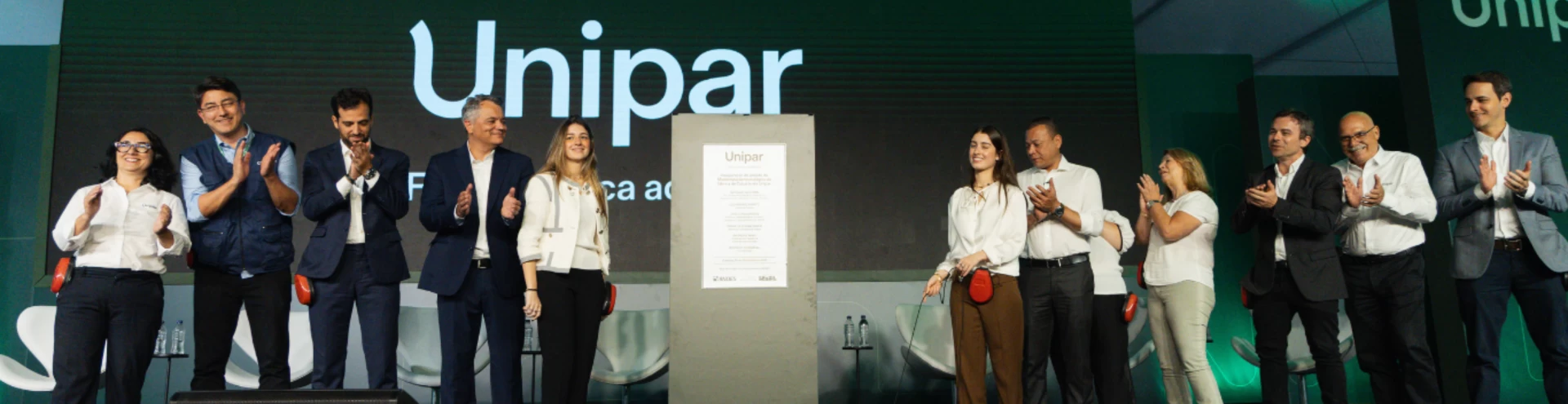
This Monday (December 15), Unipar celebrated the delivery of the technological modernization of its Cubatão (SP) plant, at an event that brought together authorities, industry representatives, customers, partners and employees. More than the presentation of a project, the event symbolized a milestone in the company’s history: the largest investment ever made by Unipar, responsible for an environmental, social and operational transformation that repositions the company among the world’s most advanced producers of chlorine and caustic soda using membrane cell technology.
“The technological modernization of Unipar’s Cubatão plant reinforces our strategy of sustainable growth, competitiveness and commitment to ESG pillars. The project is a milestone in the transition to low-carbon technologies, demonstrating that economic growth, competitiveness and socio-environmental responsibility go hand in hand,” highlights Rodrigo Cannaval, CEO of Unipar.
The investment of more than R$ 1 billion made it possible to fully replace mercury- and diaphragm-based technologies with the exclusive use of membrane cells, currently considered the most efficient, safest and lowest-impact method for chlorine production. As a result, Cubatão now operates the largest membrane unit in South America.
“The completion of this stage represents much more than an investment — it is a decisive advance in the efficiency of our operations. This project strengthens us, prepares us for the future and reinforces our purpose of being reliable and generating value in all our relationships, raising our standards of performance and sustainability,” said Rodrigo Cannaval, CEO of Unipar.
The technology will enable a reduction of approximately 70,000 tons of CO₂ emissions compared to the 2020 base year, thanks to an approximate 40% decrease in specific energy consumption (thermal and electrical) to produce each ton of chlorine. Considering total energy consumption, the reduction reaches 18% at the Cubatão plant. The initiative will also eliminate 150 tons of industrial waste per year.
In addition to efficiency gains, the plant is supplied with renewable energy from the company’s own generation. Two of Unipar’s clean energy projects — the Tucano Wind Complex (BA), with 69 MW contracted, and the Lar do Sol Solar Park (MG), with 49 MW contracted — supply electricity to the Cubatão plant, reinforcing the strategy to expand the use of renewable sources in its operations. With the use of wind and solar energy in Cubatão, green hydrogen is generated and used in the production process. This is another important element aligned with the mission of generating value with sustainability, which is part of Unipar’s DNA.
The project also enhances the company’s competitiveness by reducing fixed and variable costs, increasing operational efficiency and enabling an increase of up to 5% in product deliveries, without changes to nominal capacity.
With the completion of the modernization project, the Cubatão plant reaches 100% chlorine production using membrane technology, migrating 210,000 equivalent tons per year to the most sustainable method — an advance aligned with the Minamata Convention and a direct result of Unipar’s commitment to eliminating mercury.
During the event, guests visited the new membrane room, responsible for the main economic, environmental and social gains associated with the project.
An efficient project with impact on the community
During the implementation of the project, eco-efficient practices were adopted, such as the reuse of water in the root pile process — significantly reducing water consumption — and the use of metal formwork in the concreting of blocks and foundations, reducing wood use and waste generation at the site.
During the construction and assembly phase, the project generated more than 1,200 direct and indirect jobs, boosting the region’s economic development.
Sustainable financing
To enable the project, Unipar obtained financing of R$ 672.9 million from BNDES in November 2024, through credit lines dedicated to energy efficiency and the transition to low-carbon technologies within the Green Industry framework. This amount includes resources from the Climate Fund and FINEM – Environment. In addition, the project also has financing via an Export Credit Agency (ECA) with Euler Hermes, totaling USD 42 million.

 About UniparLeader in the production of chlorine and soda and second in PVC in South America. It is one of the main suppliers to the sanitation and construction industries, also serving the paper and cellulose, cleaning, aluminium, toy and other industries.Learn more
 Products and SolutionsUnipar offers products for different sectors and services, developing customized solutions for different needs.Learn more
 Guidelines ESGSustainabilitySustainability is part of Unipar's mission, values and strategy.Learn more